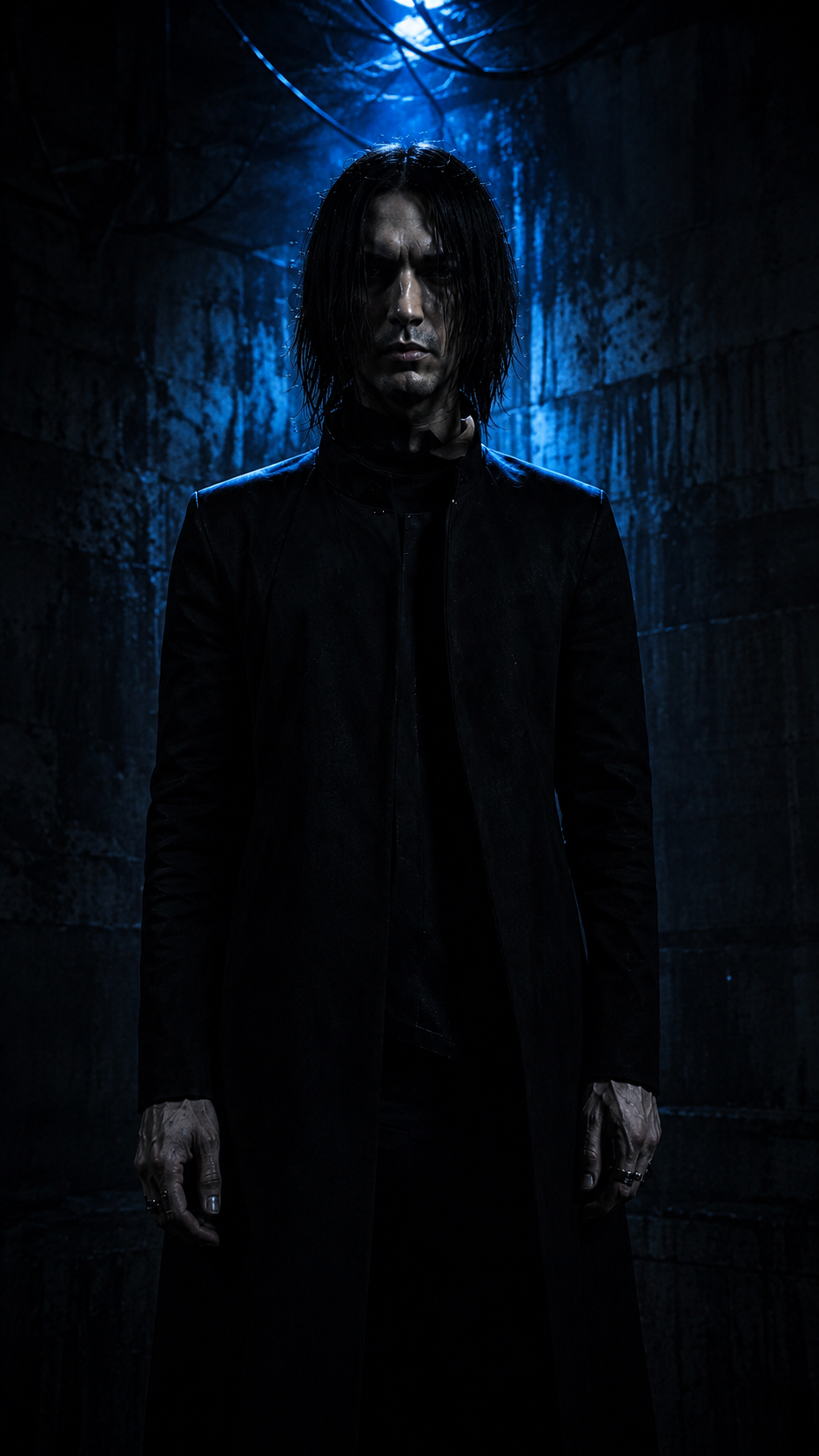
Vocals
Zael Morrow
Zael is not a name — it is a choice. The birth name was abandoned at nineteen with a calmness witnesses describe as "almost administrative." No manifesto. No public break. He simply stopped responding to the old identity, the way one stops answering a phone number that no longer leads anywhere worth going.
The surname Morrow came after. Morrow in Old English: the day that follows. Something that has not arrived yet. Something that exists only as tension between what was and what might be. He has said the name is "a position, not a history."
He has never played an instrument. He has never wanted to. What he needed was a container large enough for what was already inside — and the voice was already there. His relationship with language is central and contradictory: he carries the words but does not write them in the traditional sense. He collects phrases — on his phone, on paper, on any available surface — as though documenting incoming transmissions rather than producing content.
On stage, he holds the microphone the way one holds something that might break. All the violence is in the frequency, not the gesture. For long stretches, he is almost motionless — then, without warning, everything changes at once.
"The name they give you is the first control system. The second is the story they ask you to tell about yourself."
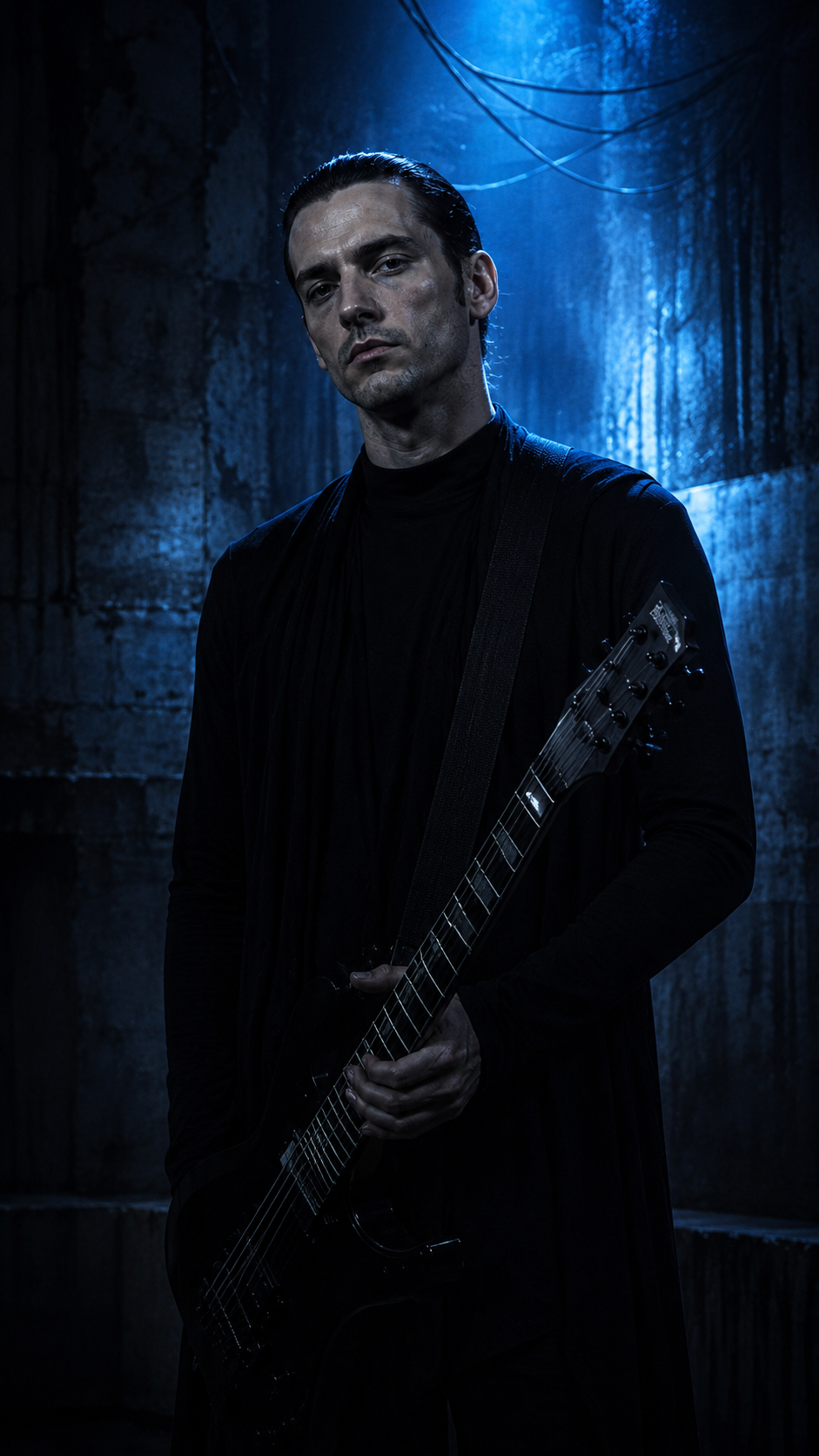
Guitar
Ren Voss
Ren is the surname. The first name disappeared from the official bio in 2022 — replaced by a blank space that no one in the group has commented on publicly. Voss remains. One syllable. Something that sounds like something falling from a precise height.
He is the band's sole guitarist, and that solitude defines his approach fundamentally. He must be everywhere at once — covering rhythmic space and constructing melodic lines without a net. He does not experience this as limitation. He experiences it as a constraint system that generates solutions two guitarists would never find, because two guitarists would divide the problem, and dividing the problem means never having to solve it completely.
His playing style is not virtuosistic in the spectacular sense. It is architectural. His lines feel like arguments — hypotheses advanced, tested, interrupted before their conclusion. That incompleteness is deliberate. He has said a note that doesn't arrive where you expect it makes more noise than ten that do.
On stage, his eyes are almost always closed during the most complex passages. Multiple live videos document this: the moment he closes his eyes coincides invariably with his most elaborate lines. As though the sound requires darkness to be built correctly.
"The guitar interests me as a system of questions. It does not interest me as a system of answers."
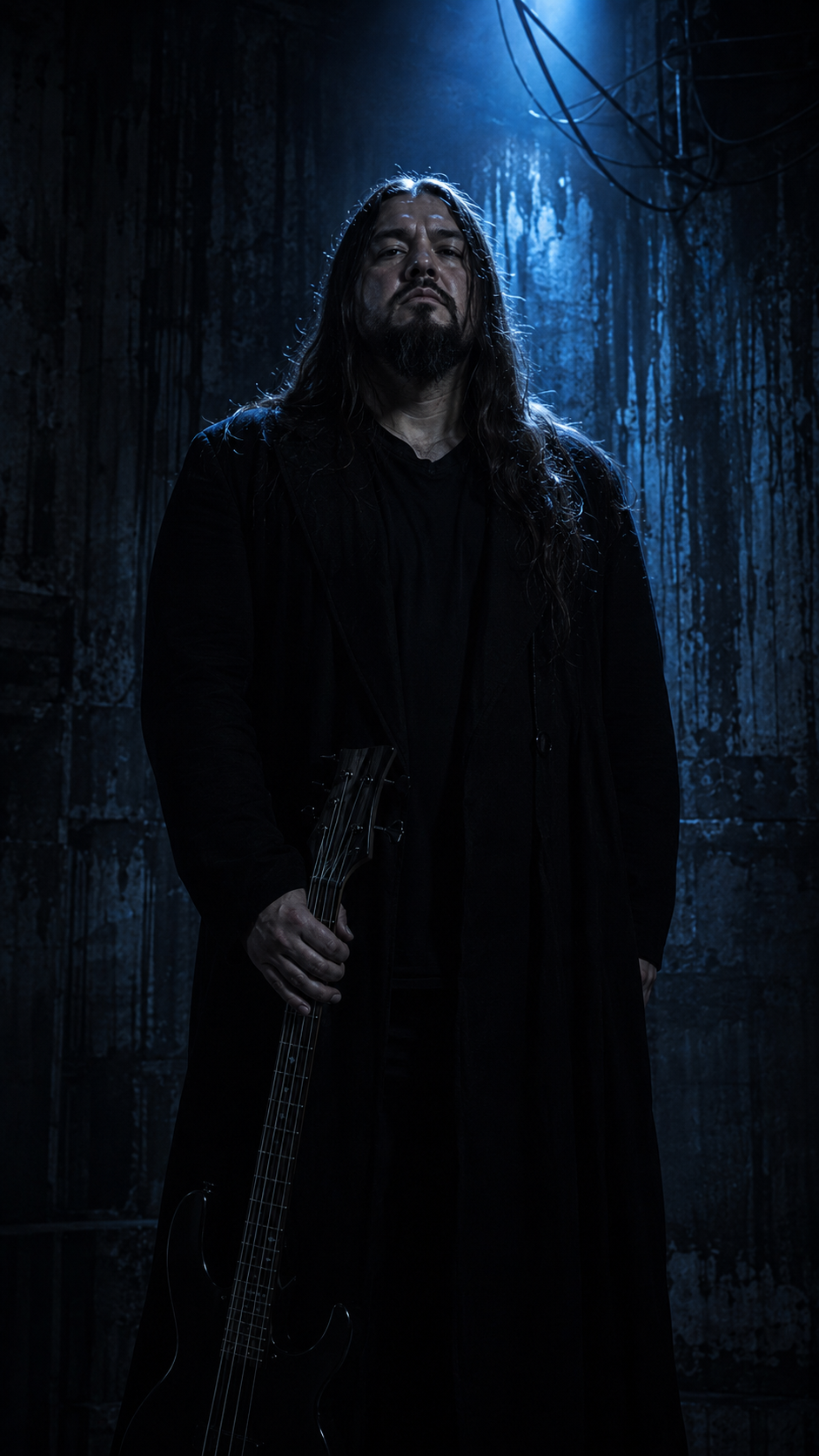
Bass
Dax Holt
Dax is the name. Holt — in certain Germanic and Nordic traditions — is an isolated copse, a stand of trees separated from the surrounding landscape. Something that delimits, that separates, that exists as a function of its distance from everything else.
He is the member about whom least is known. No individual interviews on record. No verified personal profiles. No public statement that has not passed through the band's official channels. He exists in the credits, in the sound, and in descriptions from the other members — who speak of him rarely, but when they do, use words like "fundamental" and "immovable."
His bass does not accompany. It occupies physical space. The sound is warm, low in frequency, slow to build — but once present it is impossible to ignore, impossible to remove without the track collapsing. With a single guitarist, the bass in Survival Machines carries unusual harmonic responsibility. Dax continuously negotiates with Ren the space between rhythm and melody, moving into territory that in a two-guitar band would already be occupied.
On stage he is the most static of all — more even than Zael. He positions himself and stays there. No gesture beyond what the instrument requires. The effect, combined with the physical volume of his sound, is tectonic. Something that moves so slowly it appears stationary.
No verified public statement on record.
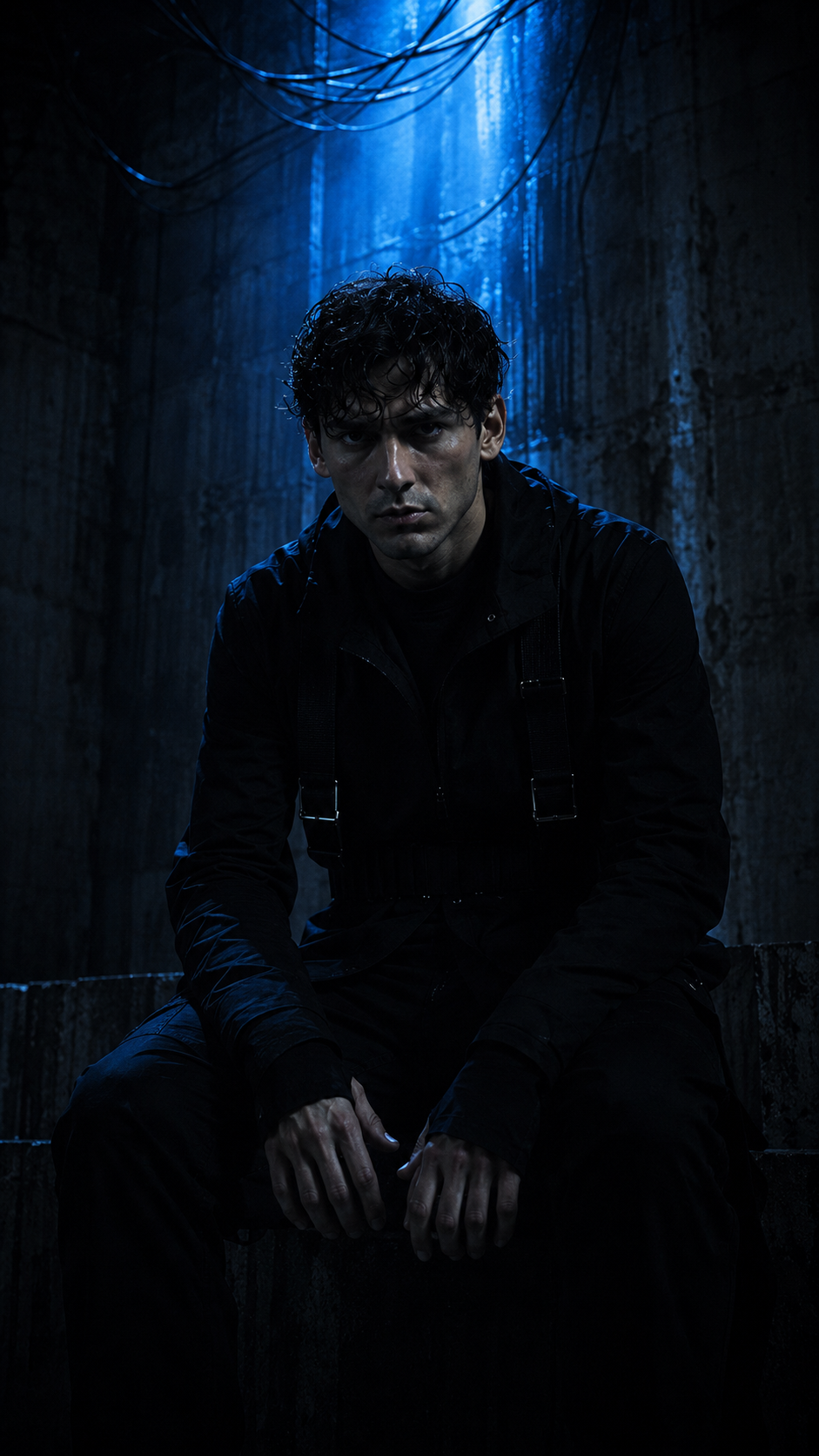
Drums
Ivo Crest
Crest — the peak of a wave. The point of maximum tension before collapse. Ivo Crest plays as though he is constantly chasing that point, knowing that reaching it means something is about to fall.
He is the only member of the group with a significant personal public presence — he runs a profile where he alternates musical content with material he describes as "unsolicited thoughts on complex systems." He almost never speaks directly about the band, but anyone who knows the lyrics of What the Wire Knows can easily trace the thematic connections.
He is entirely self-taught. He has never taken a formal drum lesson — he developed his technique through years of autonomous, non-linear self-study. The result is an approach that classically trained drummers find technically anomalous in a functional way: patterns with no name in any manual, transitions that ignore genre conventions, rhythmic solutions that sound like mistakes until you hear what happens in the following eight bars.
He is the youngest member of the group — a fact that is perceived paradoxically. He has the most explosive energy and the widest curiosity, but also a cold precision in moments of decision that surprises those who expect impulsiveness from him.
"The drums don't keep time. They decide how much time weighs."
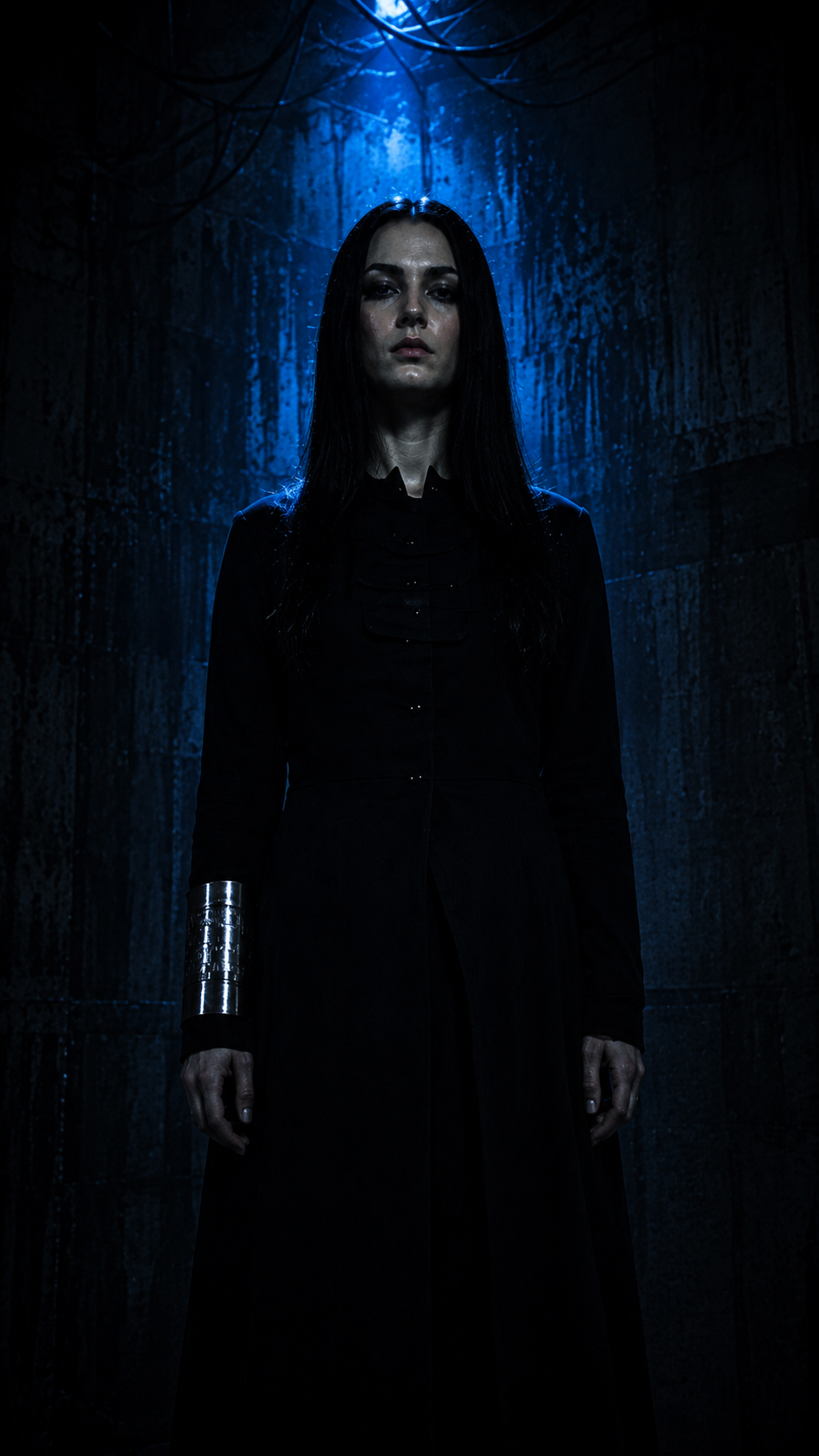
Keyboards & Second Voice
Lyra Vane
Lyra — a constellation. Small, recognizable, oriented around a single star of extreme brightness. Vane — something that measures wind direction without having chosen it, that records without deciding, that indicates without wanting to. The name works as condensed poetics: something cosmic anchored to something instrumental.
She has a long, rigorous classical training — piano from childhood, conservatory, years of music theory study in a way she describes as "total and asphyxiating." She abandoned that path not from rejection of technique but from what she calls emptiness: the moment when she knew how to play everything but felt nothing.
In the band, the keyboards are not decorative overlay. They are the atmospheric dimension of the sound — the space in which the tracks breathe, or stop breathing. Her voice appears in the songs with deliberately low frequency and near-surgical precision, in the moments when the narrative tension requires something Zael's voice alone cannot provide. Not traditional harmonic support: an intervention. Something that alters the density of the text, opens it, complicates it, calls it into question.
She has a notebook — physical, not digital. No member of the group knows exactly what it contains. Ivo has said that he once saw it open by accident and that "it looked like a language I had never seen but could have learned." Lyra did not comment.
"Silence isn't absence. It's the moment when sound decides what it means."